Books
Step into worlds both real and imagined as you explore Norman Barrientos’ range of written work.
His expertise as both a technical and creative writer will take you through the inner workings of the country’s best fleet facilities all the way to the soaring skies of WWII!

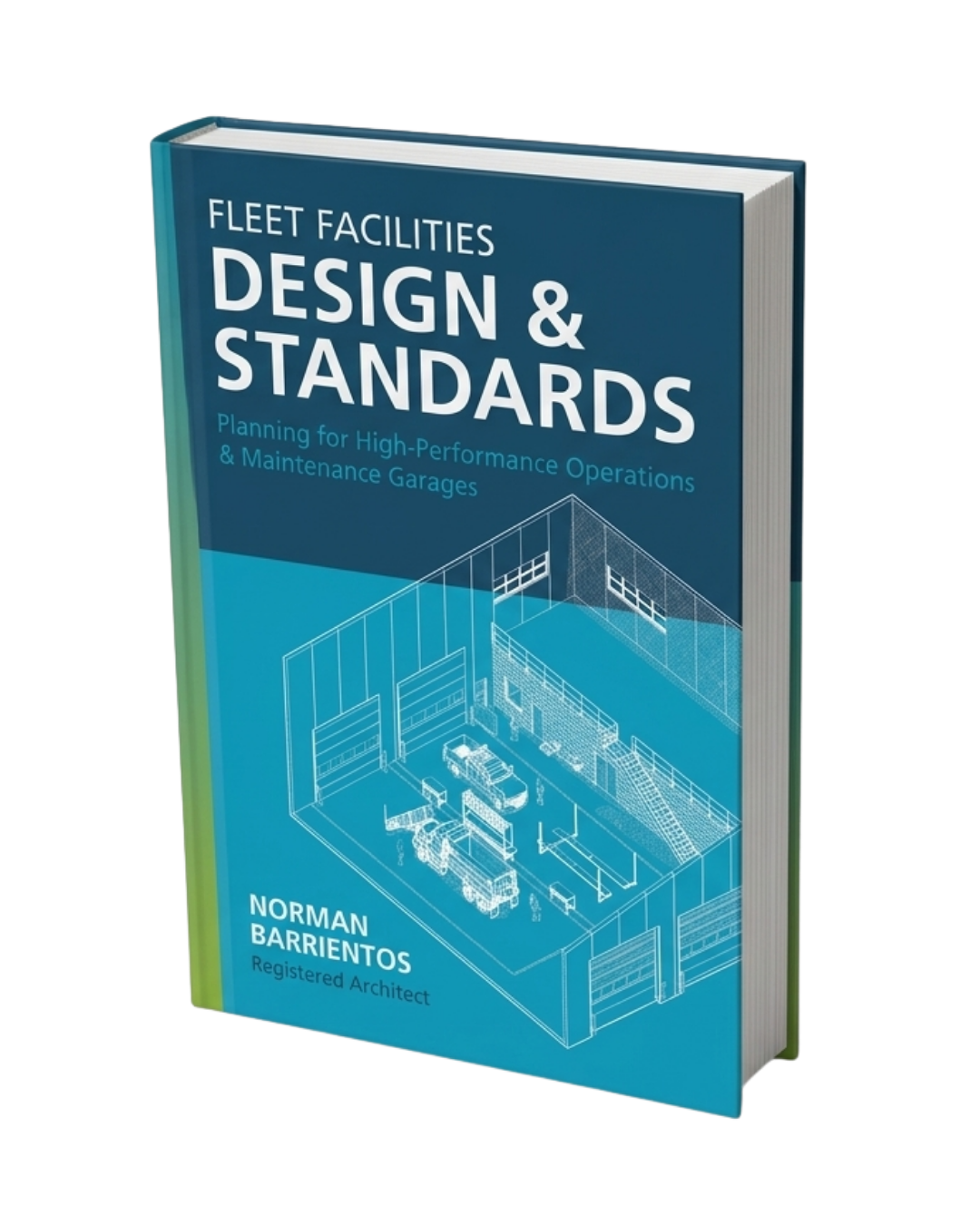
Fleet Facilities Design & Standards: Planning for High-Performance Operations and Maintenance Garages
Fleet Facilities Design & Standards is your definitive industry guide for purposeful garage design. This strategic resource systematically details essential design principles for high-performing maintenance facilities, covering workflow optimization and productivity, repair bay typologies, building and safety regulations, asset distribution and preservation, sustainability and resilience, electric vehicle service planning, and preparing garages for future technologies and long-term success.
A first of its kind in the fleet industry, this guide provides industry benchmarks and metrics enabling fleet and facility professionals to make better capital and design decisions for their fleet garage improvements. Whether you are overseeing upgrades, renovations, an expansion, or new construction, this comprehensive reference will help you make informed decisions to elevate your fleet facility design toward operational excellence.
-
Based on extensive research across over 120 maintenance facilities nationwide and nearly a decade of professional seminars, Fleet Facilities Design & Standards resolves the critical industry gap where generational facility investments are often designed without crucial field data, best practices, or national comparisons.
Discover Norman Barrientos's proven "Seven Design Principles of Highly Effective Garages" that transform O&M environments:
Robust Building Function Definition: Tailor layouts for all activities, from vehicle circulation to staff interaction.
Maintenance Workflow Optimization: Streamline movement to minimize wasted time and back-tracking.
Employee Productivity and Safety Enhancement: Create quality spaces that boost output and foster safety.
Asset Management and Distribution: Secure and efficiently track millions in inventory and vehicles.
Supervision and Security Effectiveness: Establish clear lines of sight for management and critical access points.
Building Durability and Sustainability: Select robust materials, integrate energy efficiency, and design for resilience.
Future-Ready Adaptability: Plan for transformative changes like widespread electric vehicle integration (EVSE), evolving work trucks, and digital transformation.
Learn to align facility design with your organization’s Key Performance Indicators (KPIs) and operational efficiency metrics. Understand how to determine the proper number and types of repair bays based on annual maintenance hours and technician availability. Gain crucial insights into specific design considerations like repair bay sizing, vertical clearances, and overhead door dimensions.
The book also delves into vital building material selection, recommending precast concrete panels for durability against impacts and chemical exposure. It thoroughly addresses stringent building codes and regulations, including specialized requirements for Electric Vehicles (EVs), covering charging infrastructure (EVSE), unique fire hazards (thermal runaway), and sustainability/resiliency in fleet facilities. Ultimately, this essential guide empowers you to elevate fleet facility design beyond trial-and-error, ensuring your investment leads to heightened operational efficiency, reduced costs, improved safety, and long-term asset value for decades to come.
With over 40 years of architectural design experience, Norman Barrientos is a leading expert in Operations & Maintenance facility design with over 120+ projects in his portfolio created by his Milwaukee-based architecture firm, Barrientos Design & Consulting.
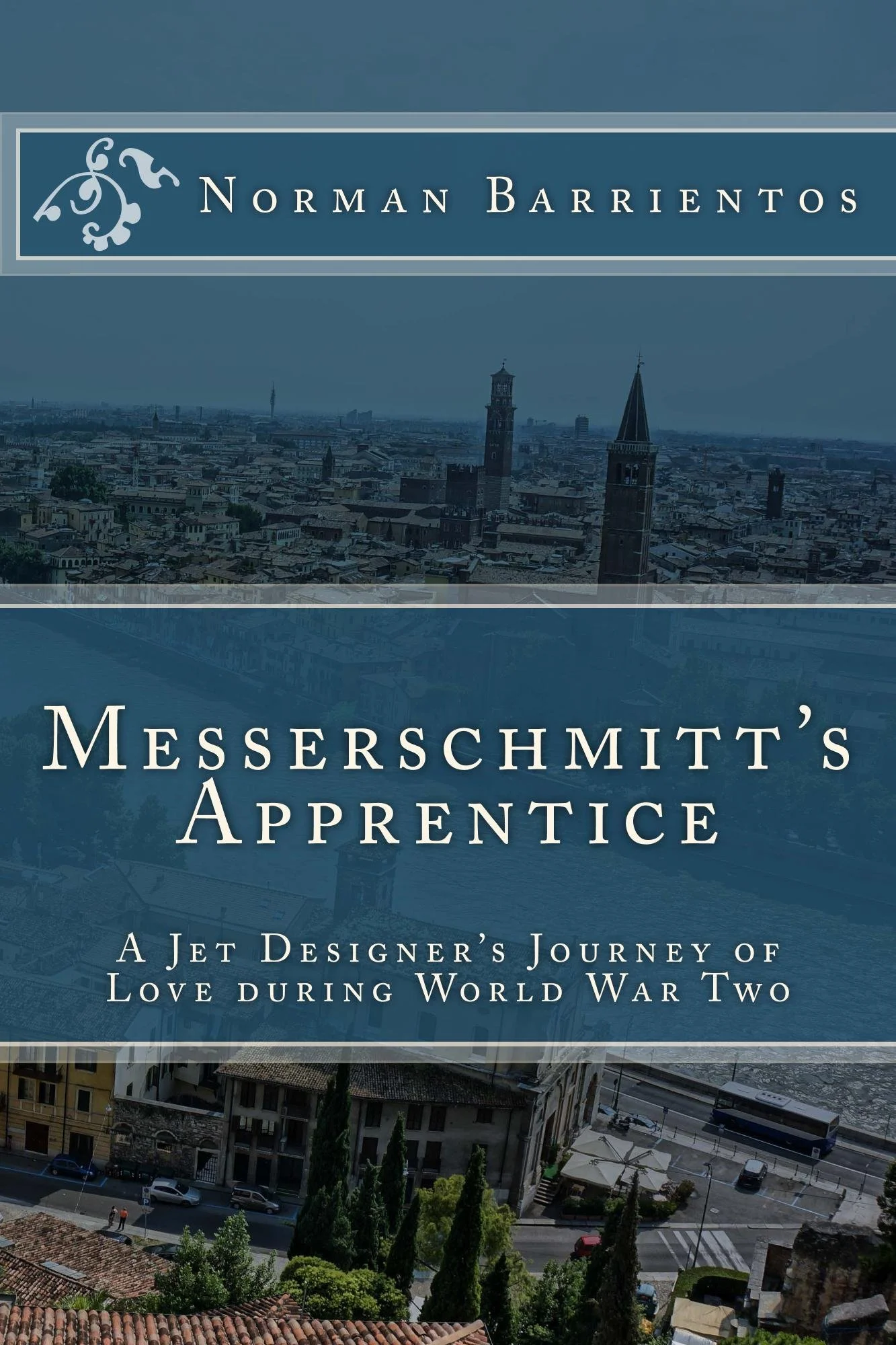
Messerschmitt's Apprentice: A Jet Designers Journey of Love and the First Jets during WWII
A moving tale of a youthful jet designer’s career aspirations during 1930s Germany and the eventual coming to terms with his aviation company's involvement in the military build-up.
Armand Kindermann graduates engineering school and joins the Messerschmitt plane company just as the Nazi Party takes over Germany. As one of the key designers of the Me 262 jet and the Me 163 rocket fighter, Kindermann rises in the company's ranks until he is reporting directly to Willy Messerschmitt.
Armand is of mixed German and Italian heritage and the rising Nazi edicts have his values and aspirations in conflict. After losing his wife and children in an air raid over Augsburg, Armand finds solace and renewal with a factory camp worker named Rosa. A forbidden and secretive love affair ensues as Rosa is Italian and Jewish. In the final months of WWII, Armand is conscripted into the Nazi Party's Volkstrum militia and his regiment is thrown against the incoming American army. Kindermann's final act in battle is insubordinate but also merciful to his remaining regiment. Once the American Air Force intelligence agencies sweep in and identify Kindermann as part of the jet design team, they intern him for interrogation and eventually "offer" him to come work for America under Operation Paperclip.
Leaving behind his home, his past family and his recent love, Armand transitions to a new life in America only to find out that Rosa has emigrated there as well. But will Rosa accept his offer to reunite or will she decide to move on with her own new life in America?
-
As an architect and creator of buildings, I know behind every physical creation is a story of many human dimensions. Including the act of creativity, the ardent pursuit of solutions, the long hours of perfecting and making it work, the client, the budgets and the schedules. So, when I looked at Germany’s advanced planes developed toward the end of WWII, and knowing their dwindling military position and industrial resources, I knew there must’ve been quite a story of human drama, sacrifice and commitment that took them far beyond the comfort and safety of normal life.
I have read many WWII history books but most have either been military focused, as seen from military and political leaders; and the others have been from the civilian’s experience of being swept up by the war. I had never read a book written by the engineers who designed and produced the military might of Germany. And I started to wonder, at what point did all these scientifically-gifted engineers realize where Nazi Germany was going and what role their technical creations would mean for Hitler’s goals? Further, I started to wonder, what sacrifices, moral oversights and challenges to authority did they, if any, undertake?
To me, when I look at the Luftwaffe aircraft, I think, who were those design engineers, who were the draftsmen of the blueprints, who were the test pilots for the companies? How many hours did they spend on that plane, its variants and working with the field units to make it operational? Did they suffer great peril from the Allied bombing campaign or were they called into military service toward the end, regardless of how ‘essential’ they were to the aircraft industry and then thrown against the Allies much like cannon fodder?
From my research, I also realized that at the end of the war, all the Allied countries found the engineers valuable strategic assets and absconded them off to their respective home countries. The United States being one of the larger importers of Nazi engineering talent with around 1500 engineers brought over under Operation Paperclip.But as I researched German aircraft design and production during WWII, I realized there was also an ugly side to it. The use of slave and concentration camp labor was intensive and extensive throughout the aircraft industry. Just to produce the Me 262 fighter jet, 54,000 slave laborers were engaged in the assembly. Many of these laborers were subject to poor living conditions, underfed, beaten by the SS guards and were exposed to Allied bombings. I thought it important that people should not just look at the German planes as wonder machines of speed, form and weaponry. Every jet also represented thousands of unnamed workers who were forced to work on these jets under deprived conditions.
I wanted to explore the decade-old question of how much responsibility and guilt do the German people, as a whole, bear for WWII atrocities. Could they have stood up to Nazism, should they have realized where it was heading, why were they so hypnotized by Hitler? What happened to Germany’s collective consciousness at the common persons’ level?
Finally, I wanted to reflect on how engineers of military weaponry, including our contemporary era, can be swept into an evil cause with or without their full consent and experience a loss of their moral compass.
⭐⭐⭐⭐⭐ 5-Star Reviews
“Great historical fiction! I really enjoyed reading this novel. It's a great combination of history and romance. It is evident that the author conducted good research for understanding and showing the complexities of being a German under Nazi rule. Moreover, the hero is a compelling character who is talented in aviation design, patriotic yet torn by the atrocities that he witnesses during WW2. I also enjoyed the romance between the hero and the young Jewish-Italian woman. Great job!”
Anette T.
“An engrossing story from a unique & fascinating point of view. Messerschmitt's Apprentice is an original, thought-provoking novel that takes you on the journey of a man driven by love for the woman in his life, and the desire to create air machines vital to his country, all while trying to survive during Hitler's rise to power and the devastation of Germany during WWII. That it is written from the perspective of a German/Italian plane designer during the most catastrophic period in German history is a door to this period in time not explored before. Definitely worth the read!”
SJC
“Great debut novel! This is a great read for anyone who likes WWII historical fiction!”
Wisconsinite
Behind the Book
Learn more about the inspiration behind Messerschmitt's Apprentice in this interview with Norman Barrientos and Ben Merens on Riverwest Radio.

From Incan Roads to the U.S. Interstate: A Bolivian Immigrant's Story
The life story of Bolivian-born engineer, co-written by Julian Barrientos and his son, Norman Barrientos. This fascinating read features Julian’s journey from early childhood growing up on a hacienda with Quechua domestics to his astounding business successes in the United States. Mr. Barrientos's story covers the relations with the indigenous people, revolutions, miners' protest, his professional struggles, deep friendships and finally the establishment of an engineering firm in the USA having at its peak 120 employees in five states.